





Lagos Holds 5-Day Strategic Workshop To Build Robust Action Plan For Health Security | Citizen NewsNG
 Citizen NewsNG
5 min read
Citizen NewsNG
5 min read
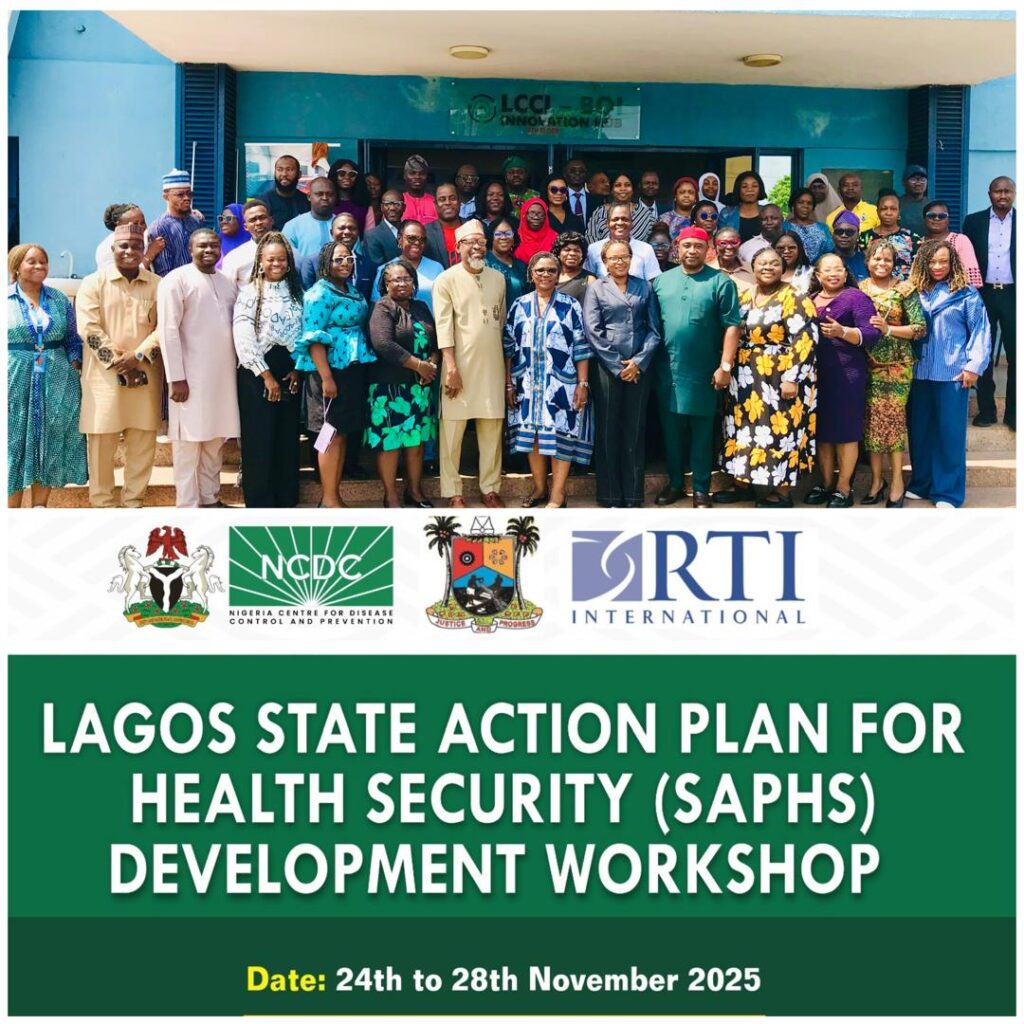
Lagos State on Monday commenced a five-day intensive, multisectoral workshop to develop the Lagos State Action Plan for Health Security (SAPHS), marking a major step in strengthening the state’s capacity to prevent, detect, and respond to emerging public health threats. The workshop, holding from November 24 to 28 at the Lagos Chamber of Commerce and Industry (LCCI), Alausa, is being convened by the Lagos State Ministry of Health in collaboration with the Nigeria Centre for Disease Control and Prevention (NCDC), with technical support from Research Triangle Institute (RTI) and the U.S. CDC.
The workshop builds on the 2024 Joint External Evaluation (JEE) of Lagos’ health security capacities and a subsequent technical planning meeting that produced a draft framework. Over the next five days, participants drawn from human, animal, and environmental health sectors are expected to translate JEE findings into a costed, implementable, and trackable action plan aligned with the International Health Regulations (IHR).
Declaring the workshop open, the Special Adviser to the Governor on Health, Dr. (Mrs.) Kemi Ogunyemi, delivered a powerful charge to participants, stressing that health security must now be treated with the same urgency as traditional security concerns. She noted that while national conversations often centre on banditry and insecurity, biological threats are rarely acknowledged despite lessons from Ebola, COVID-19, and other emerging diseases.
Dr. Ogunyemi reminded stakeholders that Lagos, as a densely populated megacity and major international gateway, remains highly vulnerable to health threats. She emphasized that preparedness for the “unknown” must be the guiding principle of the SAPHS development process. “Health is security. The next threat may not be cholera or malaria, it may be something far more unpredictable. This plan is our shield,” she said.
The Special Adviser urged participants to take ownership of the plan, stressing that the document must be expert-driven, actionable, and capable of protecting Lagos residents regardless of future challenges. She added that once finalized, the plan would be forwarded to the State Executive Council for formal adoption and deployment across sectors.
Welcoming participants, the Director of Epidemiology, Biosecurity and Global Health, Lagos State Ministry of Health, Dr. Ismail Abdus-Salam, expressed satisfaction that the long-awaited process had finally begun after months of scheduling constraints. He said the workshop represents an opportunity to produce decisions that are realistic, implementable, and aligned with shared expectations across all sectors.
Dr. Abdus-Salam highlighted significant progress already recorded by the state, including improved staffing and operations at the Public Health Emergency Operations Centre (PHEOC) and an ongoing upgrade of the facility. He noted that while Lagos has made strides, genuine improvement requires balanced progress across human, animal, and environmental health systems.
He emphasized that Lagos deliberately resisted pressure to inflate its JEE scores, choosing instead to reflect true capacity gaps in order to ensure sustainable growth. According to him, the rigorous planning model applied during the annual operational planning process must guide SAPHS development to ensure effective implementation from 2026 through 2030.
Delivering goodwill remarks, the Director of Emergency Preparedness and Response at NCDC, Pharm. Chibuzor Eneh, expressed delight at the strong turnout despite competing national engagements. Representing the NCDC Director-General, Dr. Jide Idris, she reaffirmed NCDC’s commitment to Lagos, describing the state as “our own” and a national leader in health security development.
She assured participants that additional NCDC teams would join the workshop within 24 hours, underscoring the importance attached to the Lagos SAPHS. Eneh commended Lagos’ partners, including RTI, U.S. CDC, and Resolve to Save Lives, for supporting the state’s efforts to strengthen its health security architecture.
The NCDC EPR Director expressed confidence that Lagos would develop a robust and implementable SAPHS capable of setting the national pace, noting that only a handful of states have begun similar processes. She urged stakeholders to work toward outstanding performance in the next Joint External Evaluation.
In his remarks, Senior Emergency Management Specialist at the U.S. CDC, Dr. Muhammad Saleh, emphasized that global funding shifts should not be misconstrued as cuts but as strategic reprioritization. He assured stakeholders that Lagos remains a priority for the U.S. government in health security programming.
Dr. Saleh referenced the newly launched National Action Plan for Health Security (NAPHS 2.0), cautioning Lagos to avoid pitfalls from the previous cycle, which saw only 10–15% implementation. He stressed that SAPHS must be unified, coordinated, and backed by a strong monitoring and evaluation framework to avoid stagnation.
Also speaking, the representative of RTI, Dr. Olusola Abioye, commended NCDC and Lagos State for their dedication to SAPHS development despite the state’s intense operational demands. He said Lagos has the potential to remain at the forefront of health security nationally and expressed confidence that the workshop would produce a focused, streamlined, and multisectoral plan.
Dr. Abioye underscored the importance of documentation and archiving, noting that lack of proper records affected Lagos during external evaluations. He urged the state to preserve all health security documents to strengthen institutional memory and ensure continuity.
The representative of the World Health Organization (WHO), Dr. Memuna Esan, noted that Lagos has shown consistent commitment over the last three years, improving both documentation and practical implementation across technical areas. She applauded the strengthening of One Health collaboration, citing joint investigations into anthrax and rabies.
According to her, WHO remains fully committed to Lagos’ surveillance and health security strengthening efforts, adding that improvements made this year should reflect in the state’s next evaluation scores.
Addressing the gathering, Assistant Director of Health Promotion at NCDC, Dr. Olubunmi Olofa, congratulated Lagos for its leadership, noting that only six states have reached the SAPHS development stage. She emphasized that the workshop seeks to translate JEE findings into strategic priorities for the 2026–2030 planning period.
Dr. Olofa said the SAPHS will feed into an annual operational plan to ensure phased delivery and accountability. She also highlighted the importance of inaugurating the SAPHS Implementation Coordination Unit and introducing the SAPHS Tracker to monitor progress quarterly.
Participants are expected to break into technical working groups covering 14 technical areas, including surveillance, laboratory systems, antimicrobial resistance, emergency response operations, risk communication, and One Health. The final SAPHS will undergo validation before presentation to the State Executive Council.
The workshop continues through the week, with partners expressing optimism that Lagos will once again demonstrate national leadership in health security preparedness and multisectoral coordination.
For Advert, Event Coverage/Press Conference Invite, Story/Article Publication & Other Media Services
Contact Us On WhatsApp
Send Email To: citizennewsng@gmail.com
Visit Citizen NewsNG To Read More Latest and Interesting News Across Nigeria and the World