





 Citizen NewsNG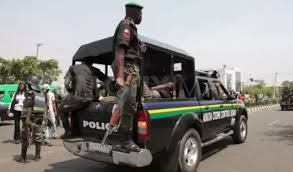
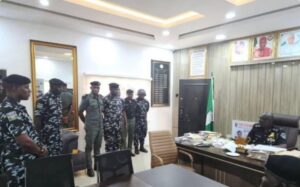
Photo illustration
The Federal High Court in Warri, Delta State, has ruled that Nigerians have the constitutional right to record police officers performing their duties in public, setting a major precedent for accountability and civil liberties.
Delivering the judgement on Tuesday in a suit marked FHC/WR/CS/87/2025, the judge, H. A. Nganjiwa, emphasised that police officers must wear visible name tags, display their force numbers, and refrain from harassing, intimidating, arresting, or confiscating devices from citizens who record their actions.
The court awarded the applicant, Maxwell Uwaifo, N5 million for the violation of his fundamental rights and an additional N2 million for litigation costs.
All of the applicant’s prayers were granted, reinforcing the public’s right to document police activities in public spaces without fear of reprisal.
“This judgement has significant implications for policing standards, civil liberties, and public accountability across Nigeria,” Mr Uwaifo said in a statement shared with PREMIUM TIMES on Tuesday.
“The court made far-reaching pronouncements on police accountability and citizens’ constitutional rights.”
The applicant, Maxwell Uwaifo
How it started
The suit was filed as a public interest litigation by Mr Uwaifo, challenging the legality of police stop-and-search operations conducted without officers displaying name tags or force numbers.
The suit named the Inspector-General of Police, the Nigeria Police Force, the Police Service Commission, and the Attorney-General of the Federation as respondents.
Filed under the Fundamental Rights (Enforcement Procedure) Rules, 2009, and relevant sections of the Nigerian constitution, the suit also cited provisions including Sections 34, 35, 36, 37, 38, 39, 41, and 46, as well as Articles 5, 6, 7, 9, and 11 of the African Charter on Human and Peoples’ Rights.
In the originating summons, the applicant asked the court to determine whether citizens can legally record police officers and whether harassment or arrest for recording constitutes a violation of fundamental rights.
Prayers
Mr Uwaifo sought declarations affirming that Nigerians are entitled under Section 39 of the Constitution to freely express themselves, including recording and publishing matters of public interest, particularly police conduct in public.
He asked the court to declare that any attempt by officers of the Nigeria Police Force to prevent or punish such recording—whether through threats of arrest, harassment, intimidation, or seizure of devices—is unconstitutional, unlawful, and a violation of fundamental rights.
He also prayed for an order of perpetual injunction restraining the Respondents, their officers, agents, privies, or anyone acting under their instructions from harassing, intimidating, threatening, arresting, or otherwise infringing upon the rights of the applicant or any Nigerian citizen in relation to recording police officers on duty in public.
Additionally, Mr Uwaifo sought a declaration that police officers conducting patrols, stop-and-search operations, and other public interactions without wearing uniforms that visibly display their names and force numbers act unconstitutionally and illegally.
He further prayed for an injunction restraining the Respondents and their agents from carrying out stop-and-search or checkpoint operations without ensuring that all operatives wear full uniforms bearing their names and force numbers.
The applicant asked the court to direct the Police Service Commission to issue clear guidelines and training for all officers of the Nigeria Police Force, affirming the public’s right to record and report police activities in public spaces, including at checkpoints and during stop-and-search operations.
He also requested that relevant authorities discipline any officer found to have acted in breach of these constitutional rights, and that the Police Service Commission issue circulars or directives mandating all officers on public duties to wear full uniforms with proper identification while initiating disciplinary proceedings against defaulters.
He prayed for an award of N80,000,000 as general and exemplary damages against the Respondents for repeated violations of the rights of himself and members of the public, as well as any further orders the court may deem just and appropriate.
The judge granted all of the applicant’s prayers.
Anonymous policing allegations
In his affidavit, Mr Uwaifo recounted multiple incidents in which he and other citizens were stopped by officers operating from unmarked vehicles, dressed in incomplete uniforms, and refusing to identify themselves.
On 10 May 2025, while travelling from Benin to Warri, he said he was blocked by armed officers at a checkpoint, questioned aggressively without reasonable suspicion, and threatened with arrest when he attempted to record the interaction.
According to him, a similar encounter occurred in June 2025 near Effurun Roundabout in Warri.
Mr Uwaifo argued that such anonymous policing fosters impunity, enabling extortion, assault, and unlawful detention.
He maintained that these practices violate citizens’ rights to dignity, personal liberty, and freedom of expression, as guaranteed under the Constitution, the Police Act 2020, and global democratic policing standards.
Citing Section 66(1) of the Police Act, 2020, he stressed that officers must display name tags and force numbers.
He noted that no law criminalises recording public officials performing official duties and referenced rulings in I.G.P. v. Ubah (2014) and Fawehinmi v. I.G.P. (2000) to support public interest litigation.
Police support video recordings
In December 2023, the Nigeria Police Force (NPF) publicly confirmed that citizens can record officers on duty.
In a post on X, the then-Force spokesperson, Olumuyiwa Adejobi, stated that filming or photographing officers is not an offence and that harassment of those recording constitutes misconduct.
Despite repeated incidents of police brutality, particularly during stop-and-search operations, the proliferation of smartphones has made recording encounters increasingly common.
A video circulating on social media captured a tense confrontation between a police officer in Lagos and a driver wearing smart glasses, spotlighting ongoing challenges in enforcing professional conduct.
The NPF condemned the officer’s actions, promising disciplinary measures, and reiterated that recording police officers on duty is lawful.
An explainer by the Executive Director of The Liberalist, Abdullahi Tijani, clarified that while Section 37 of the Constitution guarantees privacy, it does not shield police officers performing public duties.
“Citizens have the right to observe and document their actions,” he said. “Public officials must operate within the law, making it lawful for citizens to record their activities.”
Deadly legacy of disbanded SARS
This ruling must be understood against the backdrop of Nigeria’s troubled policing history, particularly the Special Anti-Robbery Squad (SARS).
The police SARS unit was formed in late 1992 under former police commissioner Simeon Midenda, as part of the Force Criminal Investigation and Intelligence Department (FCIID), headed by then Deputy Inspector General of Police Anthony Ogbizi.
It was tasked with addressing violent crimes such as robbery, kidnapping, and firearms-related offences.
SARS became notorious for extrajudicial killings, forced disappearances, extortion, torture, blackmail, illegal organ trade, home invasions, and widespread human rights abuses.
Incidents ranged from the killing of two security guards in 1996 to alleged torture and extortion of civilians and public figures, including a 2019 case involving rapper Ikechukwu Onunaku.
Amnesty International and other human rights groups repeatedly documented the squad’s abuses.
Despite repeated investigations and reform attempts from 2016 to 2019, SARS remained a symbol of police impunity until 11 October 2020, when it was formally disbanded following nationwide protests under the hashtag #EndSARS.
The movement drew global attention after incidents like the shooting of protesters at the Lekki Toll Gate in Lagos on 20 October 2020, and widespread demonstrations across major cities.
SARS’ formation followed a violent incident in 1992 involving the killing of Colonel Ezra Rimdan by police officers, which triggered a police withdrawal from Lagos and a spike in crime.
With an initial force of fifteen men and two Peugeot station wagons, SARS officially began operations in November 1992.
The unit operated covertly, often without uniforms, guns, or marked vehicles.
Efforts to reform or decentralise the unit included public campaigns in 2017, directives by the former acting President Yemi Osinbajo in 2018, and the eventual replacement of SARS with the Special Weapons and Tactics (SWAT) unit.
However, many Nigerians remained sceptical about reforms due to continued reports of police misconduct and brutality.
It’s essential to acknowledge that news production incurs expenses, and we take pride in never placing our stories behind a prohibitive paywall.
For Advert, Event Coverage/Press Conference Invite, Story/Article Publication & Other Media Services
Contact Us On WhatsApp
Send Email To: citizennewsng@gmail.com
Visit Citizen NewsNG To Read More Latest And Interesting News Across Nigeria And The World