







 Citizen NewsNG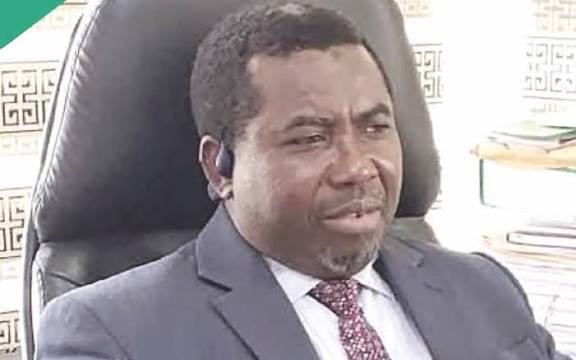
Newly confirmed Chairman of the Independent National Electoral Commission (INEC), Prof. Joash Amupitan, SAN, yesterday, began his tenure with a firm pledge that under his leadership, Nigeria will witness elections so transparent that “losers will congratulate winners.”
Amupitan, who appeared before the Senate for screening before his confirmation, said achieving such credibility would require collaboration with critical institutions like the National Identity Management Commission (NIMC), Nigerian Communications Commission (NCC), and other relevant agencies.
“Our ultimate goal is to make elections so credible that even the loser will be able to congratulate the winner in good faith, just as a judge delivers judgment and both sides accept it as fair and just,” he told senators during the session.
After nearly three hours of questioning, the Senate confirmed his appointment, following a motion by Senate Leader, Opeyemi Bamidele (APC, Ekiti Central), seconded by Senate Minority Leader, Abba Moro (PDP, Benue South).
READ ALSO: Tinubu Seeks Senate Confirmation Of New INEC Chairman
The President of the Senate, Godswill Akpabio, declared the confirmation unanimous, saying there was no dissenting voice.
He urged Amupitan to ensure that “every vote counts” in future elections.
Amupitan succeeds Prof. Mahmood Yakubu, who served as INEC chairman for ten years before stepping down on October 7.
Before addressing the Senate, Akpabio confirmed that Amupitan had been cleared by the Department of State Services (DSS), National Security Adviser (NSA), and Inspector-General of Police (IGP).
Responding to questions, Amupitan clarified that he had no partisan political involvement, dismissing claims that he led any legal team for President Bola Tinubu or the All Progressives Congress (APC) during the 2023 presidential election.
“I did not lead the legal team of the President at the Presidential Election Petition Tribunal. I did not appear at the Tribunal, either at the Court of Appeal or at the Supreme Court. I was not a member of any team,” he said.
Amupitan, a Professor of Law from Kogi State and former Deputy Vice-Chancellor of the University of Jos, stressed that his first duty would be restoring public confidence in the electoral system.
He promised to audit INEC’s Result Viewing (IReV) portal and the Bimodal Voter Accreditation System (BVAS) to address glitches that marred public trust during the 2023 polls.
“I believe what happened in 2023 was a glitch. Based on Supreme Court rulings, it became clear that the purpose of IReV was misunderstood. The court later clarified that IReV is not an electronic collation system but a safeguard for comparison,” he explained.
He added that the IReV portal was designed to promote transparency by providing checks and balances, complementing manual collation processes allowed by law.
“When we assume office, we’ll assess existing infrastructure, review the technology, and adopt the best approach that enhances transparency and credibility in elections,” he assured.
Amupitan emphasized the need for collaboration with agencies like NCC, NIMC, and service providers to ensure technological reliability.
“There will be an audit of the system and logistics of elections. We all know the problems, but we’ll find proper strategies to confront them head-on,” he stated.
He announced plans to establish an Ethics and Compliance Committee within INEC to probe electoral misconduct, supported by a whistleblower policy to protect those reporting irregularities.
“We plan to develop a system that can detect, investigate, and prosecute misconduct, supported by forensic methods when necessary,” Amupitan said.
He stressed that accountability must become the standard, citing cases where offenders in Bayelsa and Adamawa were successfully prosecuted.
“We will follow through on such cases to ensure accountability,” he added.
Addressing logistical and security challenges, Amupitan pledged to work closely with the Joint Committee on Election Security to safeguard materials, personnel, and voters.
“We’ll invest more in logistics and technology to ensure every part of Nigeria is adequately reached. If necessary, we can deploy drones or other secure means to guarantee delivery of election materials. No voter will be left behind,” he said.
He also promised to harmonize conflicting provisions in the Electoral Act, particularly regarding election timelines, to eliminate ambiguities and reduce post-election disputes.
“A clear and consistent electoral timetable will help build public confidence,” he said.
On financial prudence, Amupitan assured the Senate that INEC would strictly comply with the Public Procurement Act and Finance Act, using funds solely for approved purposes.
“Our approach will be guided by integrity, accountability, security, efficiency, and education to ensure elections truly reflect the will of the people,” he declared.
Meanwhile, Senate consideration of the Electoral Act Amendment Bill 2025 suffered a setback yesterday, as deliberations were stood down after debate turned contentious.
The bill, presented by Senator Simon Lalong (Plateau South), seeks to repeal and reenact the 2022 Electoral Act, introducing comprehensive reforms, including moving the 2027 presidential and governorship elections to November 2026.
Lalong said the 2023 polls exposed deep flaws in Nigeria’s electoral process, including funding delays, voter register disputes, result transmission controversies, and weak enforcement of electoral offences.
“Nigerians expect us to respond not with patchwork corrections, but with a holistic, future-facing law that restores faith in our elections,” he said.
However, disagreement arose when Senator Titus Zam (Benue North East) urged immediate passage of the bill for second reading. Senate President Akpabio intervened, requesting details of the proposed amendments.
Akpabio recounted his personal experience from the 2019 elections, lamenting that justice was mishandled.
“The returning officer, instead of being treated fairly, was turned into a scapegoat. The professor was wrongly sentenced to three years in prison. Clearly, something went wrong, and justice was misplaced,” Akpabio said.
He further highlighted flaws in election timelines and campaign periods, arguing that lengthy pre-election activities hinder governance.
“When you add campaign time to pre-election processes, a significant part of a four-year term is lost. Those meant to serve the nation barely have time to make a real impact,” he noted.
Akpabio concluded by urging lawmakers to ensure clarity in the proposed amendments. Following deliberations, Senate Leader Bamidele moved a motion, seconded by Moro, to stand down the bill pending further review.
For Advert, Event Coverage/Press Conference Invite, Story/Article Publication & Other Media Services
Contact Us On WhatsApp
Send Email To: citizennewsng@gmail.com
Visit Citizen NewsNG To Read More Latest and Interesting News Across Nigeria and the World